


I hear it all the time: “We’ve tried everything.” Sticker charts, rewards, timers, scheduled bathroom breaks. Maybe you’ve been navigating urine leakage, constipation, encopresis, or stool withholding. You might celebrate a successful day, and then the next day, it’s back to square one.
If you’re a parent, you might be wondering what might help you better understand your child’s toileting experiences. If you’re an occupational therapist or educator, you may have strategies that help to a point, but still leave questions about how to fully support the person in front of you. And if you’re navigating your own toileting challenges, you might be experiencing body signals that aren’t always clear or predictable the way they seem to be for some people.
Enter interoception. By learning body cues through targeted interoception activities for toileting, we can support people of all ages in developing more agency, comfort, and confidence around toileting. I’m encouraged to see more and more professionals and caregivers becoming familiar with the role interoception plays in successful toileting—whether it’s urination or defecation (let’s just call it successful peeing and pooping, shall we?).
By incorporating interoception into toileting programs, we can help make the experience more intuitive and effective for everyone.
What Is Interoception? (And Why Does It Matter for Toileting?)

Interoception is the sense within our bodies that allows us to experience internal sensations such as a racing heart, a growling stomach, a full bladder, tingling potty parts, or wet skin. Having body signal awareness is essential to understanding what’s happening inside us and what our bodies need to stay regulated.
Let’s start by breaking down how interoception works for many of us who experience independent toileting and regulation. For many, they notice specific sensations within their body. These sensations are different for everyone. Over time, as we repeatedly experience our unique sensations, we learn to assign meaning to them. In other words, what do these sensations mean uniquely to me?
For example, we might learn that a certain pressure feeling in our lower belly area means we need to pee, and that becomes our drive to get to the bathroom in time. Similarly, when it comes to pooping, we may notice a particularly full and tight sensation in our bowels and come to understand that it means we need to poop. The sensations then serve as a signal, motivating us to find a toilet so we can eliminate it safely and effectively.
Essentially, interoception allows us to notice what our bodies are uniquely feeling, and understanding these internal signals is key to regulating our toileting needs. It is different for all of us. How your body feels when you need to pee or poop is likely distinct from the way my body feels. We are all valid in our unique interoceptive experiences.
When we incorporate interoception skill-building into toileting support, we move from compliance-based approaches to curiosity-driven understanding. And that changes everything.
The Problems with Most Toileting Programs
Unfortunately, most toileting programs don’t incorporate interoception. Instead, many tend to be very externally oriented and compliance-based, focusing on surface behaviors, like counting the number or frequency of successful toileting attempts or unfortunate accidents, without acknowledging the underlying factors contributing to toileting progress. Simply giving a child sticker after sticker won’t magically develop the interoception and other foundational skills they need for successful toileting.
For many people, including autistic individuals and those with sensory processing differences, interoceptive awareness can be particularly challenging. Some people have heightened awareness (feeling too much, all the time), while others have reduced awareness (not noticing signals until they’re screaming urgently). Understanding your unique interoceptive profile, your child’s, or your student’s is really the first step toward building toileting support strategies.
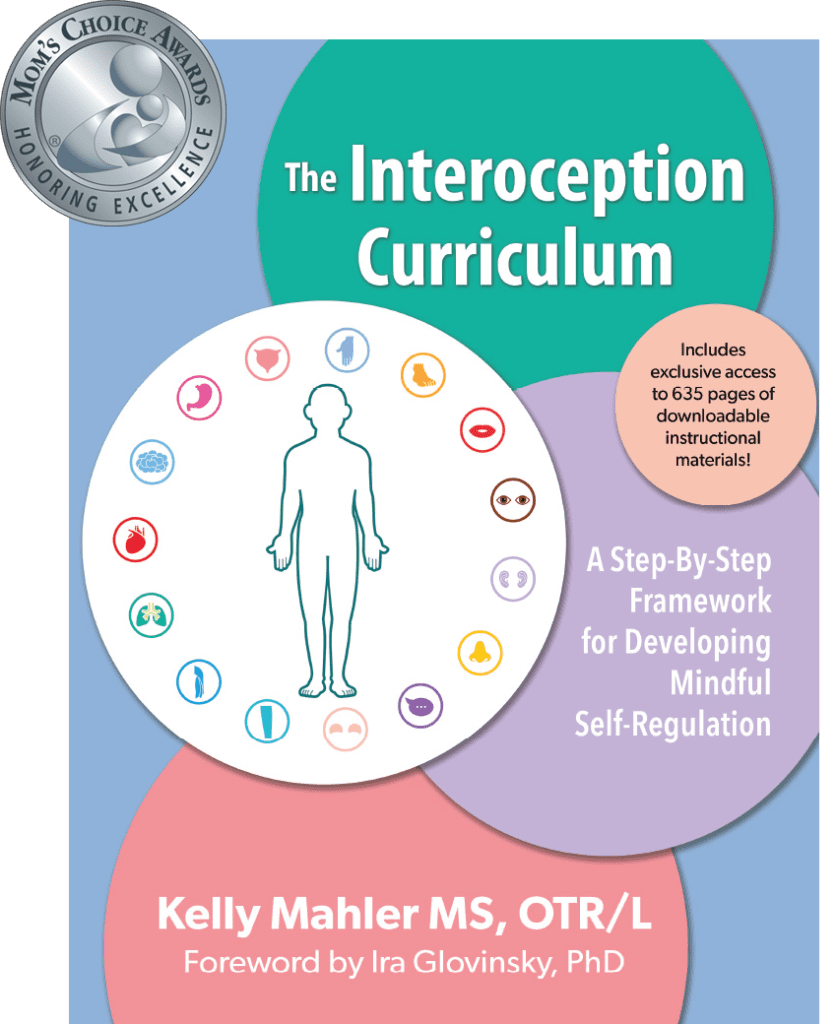
Start by incorporating The Interoception Curriculum©. This resource can be a game-changer for addressing toileting difficulties. This publication stands out because it actively teaches individuals to recognize and interpret these bodily signals, laying a strong foundation for increased self-awareness and confidence. This curriculum was the first of its kind. A systematic, neurodiversity-affirming approach to building body awareness. And I’m honored that this work has been recognized in places like U.S. News & World Report, The Wall Street Journal, TIME, HuffPost, and The Associated Press.
How Interoception Skill Building Helps Parents
One of the most challenging but amazing parts of parenthood is realizing your child is their own person. You see your child has their own opinions, thoughts, and, sometimes, very complicated and difficult-to-describe feelings. Struggling alongside your child to understand what’s going on inside their body can be emotionally exhausting. This is where interoceptive training can really help. And honestly? While I’m grateful that my work has been recognized in major publications, the real recognition comes from the families who tell me this approach changed their lives. That’s what matters most to me.
Here’s what Dani shared about her family’s experience:
“When we took the Interoception and Toileting course, our son was only 3, and potty training just wasn’t clicking yet. Over the next two years, we tried everything: rewards, charts, you name it. But when our son turned 5, and we were still facing the same struggles, we knew we needed a new approach. That’s when my husband and I decided to revisit Kelly’s course together.
The results were nothing short of incredible. Within just two weeks, we saw more progress than we had in years of trying. Her insights on helping our son recognize and understand the signals his body was giving him were game-changing. In just one month, he went from not communicating his bathroom needs to confidently recognizing when he had to go.
He even started telling his preschool teachers when he needed to use the potty! We are beyond proud of his growth, and most importantly, he is so proud of himself. Thank you for giving us the tools to support our son’s success in potty training.”
– Danielle Black
Why Doesn’t External Reinforcement Work?
Rewards, sticker charts, and alarms often don’t work for successful toileting because they fail to acknowledge the “deep whys” of many toileting challenges. For example, does the external reinforcement consider:
Sensory Processing
The child may be fearful of the toilet flushing or not like the feeling of toilet paper on their hands.

Core/Postural Stability
Sitting on the toilet might feel physically unsafe or unstable, especially for smaller children or those with low muscle tone.

Pelvic Floor Muscles
The person could struggle to relax the pelvic floor muscles enough for peeing and pooping to happen.

Anxiety
A person might need to learn nurturing or comfort strategies to feel safe in the bathroom in order to use it.

Medical Conditions
The person could have an underlying medical need, like chronic constipation, encopresis, or urinary tract infections.

Nutrition
They may have a food sensitivity or limited nutrient intake that affects peeing and pooping patterns.

Interoception
The person might not yet notice and understand internal body signals that indicate they need to pee and poop.

Communication
Some may struggle to express their toileting needs, understand toileting language, or be non-speaking.
Interoception and Toileting Regulation
So, how can interoception better help with toileting? For effective toileting regulation, people need to develop a keen sense of their internal signals. One way to help people learn this sense is to read The Interoception Curriculum©, which provides a framework for building independent self-regulation. This way, they can:

Interoception is the inner sense of self that connects all of these steps. This sense tells us when we need to stretch our legs, when we’re feeling happy, and yes, when we need to pee or poop. This sense can be difficult for some of us to really connect with, which can make toileting difficult or lead to accidents.
The core of self-regulation activities, including toileting regulation, is recognizing these inner feelings that are connected with the need to use the restroom. These sensations will vary from person to person. This is why connecting to our body and developing an understanding of what our body is uniquely telling us is so important.
💩How Do You Know When You Need To Poop? 💩
Our social media is full of great interoception discussions, including this post that really highlighted how different each of our bodies can feel when we need to poop! Gone are the days of teaching the way an emotion or experience “should feel.” Here are the days of exploring and celebrating unique interoceptive experiences. Do you resonate with any of these interoception experiences?
- I think of it as “pressure” personally
- Need to poop is a heaviness and pressure near my butthole
- I feel the jiggle
- A slight tingle
- My stomach hurts
- A pushy feeling around my bum
- Tickly in the lower abdomen
- Muscles are tighter from holding it in
- Because I can taste it
- Honestly, the poop feeling is not there. It is often a surprise
- I get a headache and feel hot
- My tummy feels hard
- I have a pucker sensation down below
- I get pain in the stomach—it is left-sided and crampy (like if someone is squeezing the area with their hand, hard and fast)
Do you see the diversity here? This is exactly why one-size-fits-all toileting support strategies so often fail. Each person needs to discover their own unique body signal awareness, and interoception training supports exactly that kind of exploration and discovery.

Interoception Activities for Toileting
In collaboration with various colleagues and graduate students, I’ve spent the past few years conducting the first pediatric studies to investigate the outcomes of interoception-based interventions in areas like toileting and emotional regulation.
From these studies, we’ve learned that, for some learners, as they develop their interoceptive awareness, they may be dry during the day but still experience nighttime bedwetting, which is very common. However, as the child continues to practice tuning into their internal signals, they often gain enough interoceptive awareness for those nighttime accidents to disappear eventually.
I don’t mean to oversimplify toileting, as we know many underlying factors contribute to success. Still, our studies have highlighted the importance of incorporating interoception practices into the toilet training process.
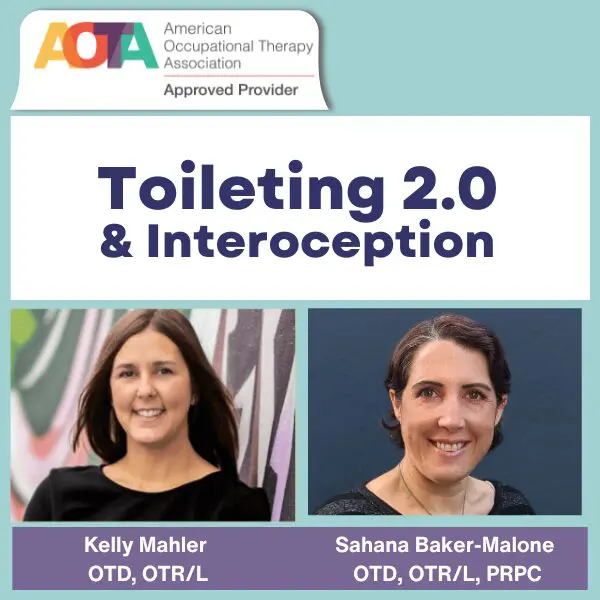
If you’re interested in exploring interoception and toileting further, we invite you to join us for our On-Demand Course: Toileting, Interoception & Nutrition: An Evidence-Based Approach for Promoting Toileting Success and Independence. In this class, we share practical, evidence-based strategies that are easy to implement and suitable for learners of all ages, backgrounds, diagnoses, and learning styles.
Let’s Start This Interoception & Toileting Journey Together
Toileting challenges can feel overwhelming. Maybe you’ve been at this for months or even years. Maybe you’re tired, worried, or second‑guessing yourself.
But here’s what I want you to know: You’re not failing. Your child isn’t failing. Your student isn’t failing. The traditional approaches just weren’t addressing the real issue.
Whether you’re an occupational therapist seeking evidence-based training, an educator supporting students, a parent navigating these challenges day by day, or a self-advocate working on your inner body awareness—I’m here to support you with a neurodiversity-affirming, research-based approach that actually works.
I’m Kelly Mahler, OTD, OTR/L, FAOTA. I’m an occupational therapist, researcher, and someone who genuinely believes that everyone deserves to understand and trust their own body. The Interoception Curriculum© won a Mom’s Choice Award, and my work has been featured in U.S. News & World Report, The Wall Street Journal, TIME, HuffPost, The Associated Press, and Yahoo!. But more importantly, I’ve seen this approach change lives—thousands of them.
And I’d love to support you, too. Here’s where to start:
- Join the Toileting 2.0 Course
- Comprehensive, CEU-eligible training on interoception strategies for toileting, including support for constipation, encopresis, and stool withholding.
- Read Interoception, Toileting, and Potty Training: Understanding Inner Body Signals
- If toileting has turned into a power struggle, this post will help you reframe it as a body-based interoception process (not “bad behavior”) and give you gentle, practical ways to build readiness from the inside out without relying on pressure or rewards.
- Get The Interoception Curriculum©
- The award-winning, research-based framework for building body awareness and self-regulation across all areas of life.
- Download The Adult Modeling Book
- Learn how to authentically share your own interoceptive experiences to support children’s body awareness development.
- Read Interoception and Toileting: Improving Body Awareness for Successful Bathroom Routines
- This blog explains why toileting struggles often aren’t solved by rewards alone and shows how building interoceptive body awareness can help children and clients recognize bathroom signals, reduce accidents, and gain more independence with less stress.

Frequently Asked Questions About Interoception & Toileting
I get asked a lot of questions about interoception and toileting—and I love it, because it means people are thinking deeply about how to support themselves and the people they care about. Here are some of the most common questions I hear, along with answers that I hope will give you clarity and direction on your journey.
How can I help my child understand their body signals for toileting?
Start with body awareness activities outside of toileting contexts. This is so important—we don’t want all the pressure on bathroom situations. Ask curiosity-based questions around toileting routines like “What does your tummy feel like right now?” instead of directive questions like “Do you need to go potty?” And build scheduled “body listening” times throughout the day where you both practice noticing different sensations.
Can interoception help with constipation and stool withholding?
Yes, interoception can play an important role. If constipation is present, it is often important to first address it with appropriate medical guidance. Once the constipation has been resolved, interoception approaches can support individuals in exploring and recognizing earlier body signals related to bowel movements, such as sensations of rectal fullness. For those who experience stool withholding related to past interoceptive memories where bowel movements were associated with pain, interoception approaches focus on gradually rebuilding trust with body signals and creating a safe, non-pressured environment around toileting. The key, and this cannot be emphasized enough, is developing awareness and safety around body signals rather than forcing compliance.
What are some interoception activities for toileting that I can try today?
Here are some interoception activities for toileting to get you started:
- Model your own body signals out loud (e.g., “My belly feels heavy—that’s usually my poop signal.”)
- Explore how different people notice the need to pee or poop
- Use body drawings to identify where sensations occur
- Create a bathroom environment that feels safe and comfortable
How long does it take to develop interoceptive awareness for toileting?
I wish I could give you a simple answer, but every person’s timeline is different. Some individuals show progress within weeks, while others need months of consistent practice. What the research shows is that as interoceptive awareness builds, daytime toileting often improves first, followed by nighttime control. The key is patient, consistent practice without pressure or punishment. Trust the process.
My child is autistic. Will interoception strategies work for them?
Yes! My approach is specifically neurodiversity-affirming and designed with autistic individuals in mind. Autistic people may have unique interoceptive profiles, some with heightened awareness, others with reduced awareness. My interoceptive resources respect these differences and provide individualized strategies rather than one-size-fits-all solutions. We honor each person’s unique nervous system.
What’s the difference between interoception-based toileting and traditional toilet training?
Traditional toilet training often relies on external rewards, scheduled sits, and behavioral compliance. Interoception-based approaches focus on building internal awareness and understanding of body signals. Instead of teaching when you “should” go, we help you recognize when your body is telling you it needs to go—creating sustainable, lifelong self-regulation skills instead of dependence on external prompts.
Can adults benefit from interoception work for toileting issues?
Absolutely! Many adults experience toileting challenges related to interoceptive awareness, including those with ADHD, autism, trauma histories, or chronic medical conditions. The principles of interoception apply across the lifespan.
How does encopresis relate to interoception?
Encopresis (involuntary soiling) often develops when chronic constipation dulls the interoceptive signals from the bowels. Over time, the rectum can stretch, and the brain receives fewer and fewer clear messages about the need to eliminate. Rebuilding interoceptive awareness can help individuals recognize earlier, more subtle signals before accidents occur. It’s a process, but it can make such a difference.